Blog

Environmentally Friendly Roses

By Nazia Parveen,

For the first time, scientists have developed environmentally friendly bunches of roses which are transported without any water at the bottom of the packaging.

It’s thanks to a pioneering airtight design which takes up less space and weight in lorries – saving on fuel – as well as saving on water.

With no air, the flowers are effectively put to sleep. The blooms then wake up once the packaging is removed and they are placed in water at their destination.

Marks and Spencer, which is using the technology this Valentine’s to deliver their £22 bouquet of Fairtrade red roses, said they will save 10,000 litres of water on the day – enough for 40,000 cups of tea.

M&S already uses Modified Atmosphere Packaging to transport fruit and veg but this is the first time it has been adapted for flowers.

Flower expert Charlotte Curtis said it will help to lower the retailer’s carbon footprint. ‘It means that 25 per cent less lorries will be needed to deliver these bouquets,’ she said.

The blood-red Fairtrade roses costing £22 will be moved from depot to door with the ‘ground-breaking’ new packaging design.

To see the full article from Daily Mail, click here.

New Reusable Container System

By Rick LeBlanc,

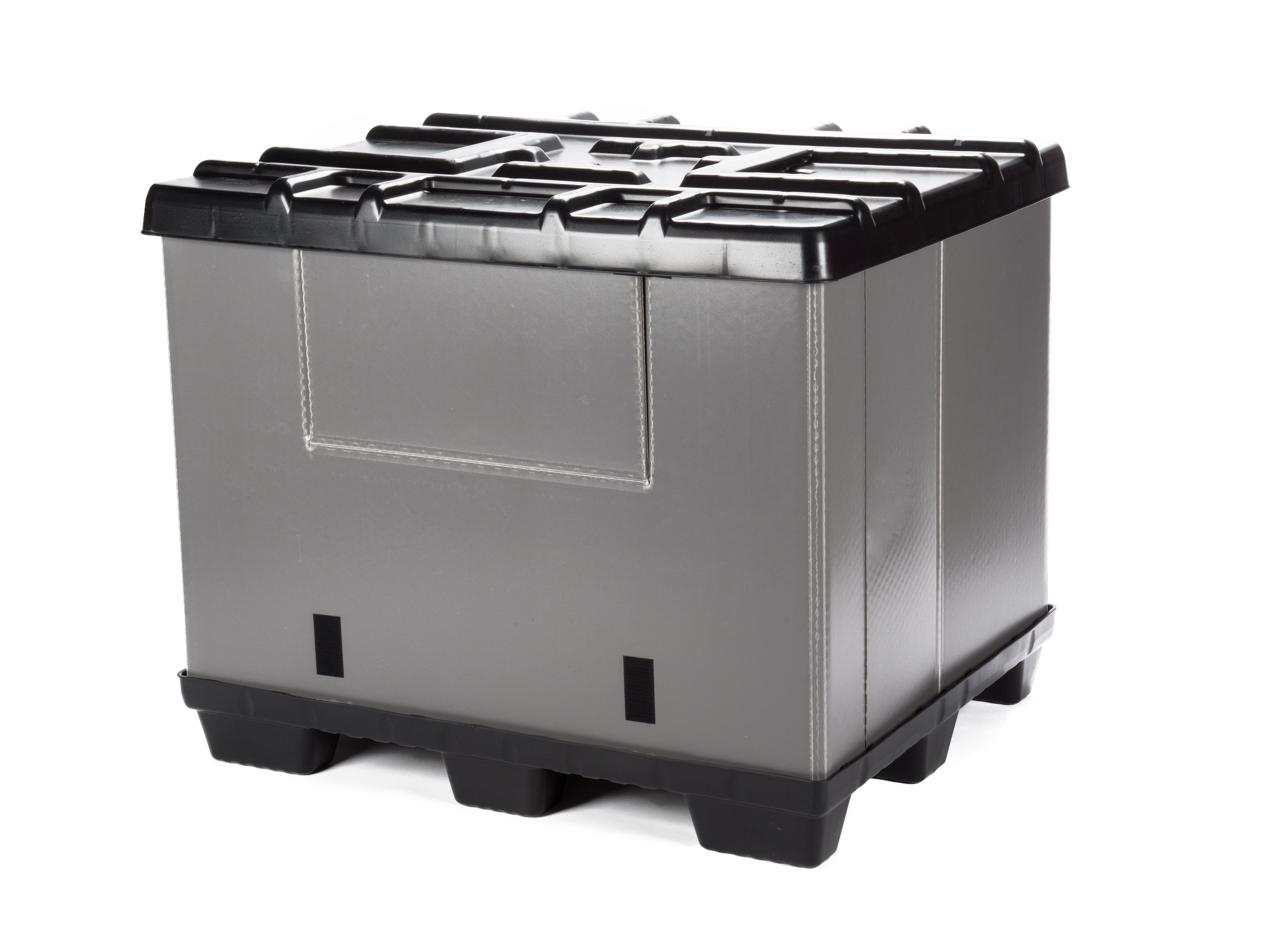
Goplasticpallets.com has announced the addition of a new lightweight modular container to its range – one it calls a cost effective alternative to existing sleeve packs. It is easy to assemble, secure and offers customers the potential to reduce their carbon footprint.

Goplasticpallets.com, the UK’s leading independent supplier of plastic pallets and containers, now stocks the Modular Pak: a lightweight sleeve pack with three components – a nestable pallet base with secure catches, a plastic sleeve and a lid. When flat packed, the container takes up minimal space and the lid fits perfectly over the pallet, protecting the sleeve from dirt and water and promoting long term reuse.

Its low tare weight is up to 15kg less than comparable containers, making high volume distribution of goods such as lightweight packaging – for food, pharmaceuticals and automotive parts, for example  –  more economically and environmentally efficient. The space saving of its flat-pack design when empty means collection and redeployment is also made easier than with comparable boxes.

Available in 1200mm x 1000mm, the Modular Pak has four simple slide catches to secure the plastic sealed sleeve to the pallet and two deep drop-down doors which have Velcro attached to keep them closed, but when open, provide easy access to goods. Special “grab” handles in the lid allow it to be easily and quickly lifted off. It’s also possible to stand one Modular Pak on top of another – ideal for where storage space is limited. They have a low operation cost and are impact resistant, capable of carrying a 500kg dynamic load or 1000kg static load.

To see the full article from Packaging Revolution, click here.

Eco-Friendly Packaging Ideas

By Cheryl Mascarenhas,

In the not-so-distant past, when plastics weren’t around and technology wasn’t that advanced, simple people used simple means for packaging. These included using wicker baskets, cloth bags, gunny sacks, and not to forget brown paper bags. Cut to the present when large-scale production came about, paper was replaced with polythene bags, wicker baskets with thermocol caskets, gunny bags and cloth bags have been replaced by plastics and more plastics. Let’s just conclude it saying:

Increase in Population = Increase in Pollution = Environmental Degradation

With the amount of waste being generated on a daily basis, isn’t it true that the Earth is turning into a huge waste basket? The astonishing fact is, that a major chunk of this waste consists of packaging waste made up of non-biodegradable material. Styrofoam, plastics, metals scraps and foils which are used in bulk to pack essential goods lie around in the landfills for hundreds of years before breaking down. This in turn takes a toll on the environment at large, and it is without doubt the slow death of Mother Earth.

Considering the damage we are already doing to the planet, we can take a step back and try our level best to reduce our carbon footprint. The smallest step we can take to reduce our carbon footprint is by bringing about a change in the way we pack our goods. There are a lot of environmental-friendly packaging methods out there, all we got to do is to tap the available resources. The mantra that will help keep the Earth green is Reduce, Reuse and Recycle. Let’s get on to mission green then, with our biodegradable wrapping ideas.

Sack Plastic, Use Bioplastic Instead

Plastic we know is sturdy and is used for most packaging, however it is not easily degradable. The biggest disadvantage of plastic is that it contains toxins which can pose a danger not just to the humans, but to other living organisms as well as to nature.

Coming back to the point, instead of plastics, use bioplastic that are made from organic substances and are 100% degradable. Bioplastic breaks down in the environment faster than the normal plastic which is made using fossil fuels. Packing food items in Cellulose Acetate, a bioplastic, is a better option than a normal plastic container or a plastic wrap. If you are wary of using bioplastic, then opt for glass bottles. Glass which can be recycled and reused is another better option that you can experiment with. There was a time when glass was used to manufacture bottles to house your favourite cola. Guess it’s high time to revert to using glass instead of plastics.

To see the full article from Buzzle, click here.

Consumers More Aware of Eco-Friendly Packaging

By Susan Carpenter,

The study from the New Jersey marketing firm Perception Research Services reports that 36% of shoppers in 2011 were likely to choose environmentally friendly packaging, a 29% increase over 2010. Half of the shoppers polled said they were willing to pay more for such packaging. One-third of the shoppers said they bought more of a product if its package was labelled “recyclable” or “made from recycled material,” and a quarter of the shoppers said they have switched brands for more eco-friendly packaging.

One in five shoppers said packaging didn’t include enough environmental information and provided confusing claims, the study found. Many respondents said they didn’t know which packaging was best for the environment.

Packaging had the biggest effect on buying behaviour if it was labelled “recyclable,” “made from recycled materials” or “easier to recycle,” or if it was marked with a recycling symbol. Packaging that said it used less material did not have as large an impact on shoppers’ decisions.

Consumers were more likely than previously to check if the packaging could be recycled before buying a product. From 2008 to 2010, just 17% of consumers checked to see if packaging could be recycled; by 2011, that number had risen to 23%.

“We’re seeing a great opportunity for manufacturers to provide truly value-added packaging to their target shoppers by making it more environmentally friendly,” said Jonathan Asher, Perception Research Services’ executive vice president. He said manufacturers that label smaller, thinner packaging as eco-friendly when the intention is merely to disguise cost reductions only tests shoppers’ goodwill.

Retailers Moving towards Greener Packaging

By Stephanie Clifford,

The Pyranna, the Jokari Deluxe, the Insta Slit, the ZipIt and the OpenIt apply blades and batteries to what should be a simple task: opening a retail package.

But the maddening — and nearly impenetrable — plastic packaging known as clamshells could become a welcome casualty of the difficult economy. High oil prices have manufacturers and big retailers reconsidering the use of so much plastic, and some are aggressively looking for cheaper substitutes.

“With the instability in petroleum-based materials, people said we need an alternative to the clamshell,” said Jeff Kellogg, vice president for consumer electronics and security packaging at the packaging company MeadWestvaco.

Companies are scuttling plastic of all kinds wherever they can.

Target has removed the plastic lids from its Archer Farms yogurts, has redesigned packages for some light bulbs to eliminate plastic, and is selling socks held together by paper bands rather than in plastic bags.

Wal-Mart Stores, which has pledged to reduce its packaging by 5 percent between 2008 and 2013, has pushed suppliers to concentrate laundry detergent so it can be sold in smaller containers, and has made round hydrogen peroxide bottles into square ones to cut down on plastic use.

At Home Depot, Husky tools are going from clamshell to paperboard packaging, and EcoSmart LED bulbs are about to be sold in a corrugated box, rather than a larger plastic case.

“Most of our manufacturers have been working on this,” said Craig Menear, the head of merchandising at Home Depot. “We’ve certainly been encouraging them.”

Shoppers have long complained that clamshells are a literal pain, and environmentalists have denounced them as wasteful. To save money and address complaints, retailers and manufacturers started minimizing packaging in the e-commerce sphere a few years ago. Amazon, for example, introduced a “frustration-free packaging” initiative in 2008 intended to defuse wrap rage and be more eco-friendly. Other retailers have also been looking for ways to improve the customer’s unpacking experience.

“As a guy in packaging, I get all the questions — there’s nothing worse than going to a cocktail party where someone’s asking why they can’t get into their stuff,” said Ronald Sasine, the senior director for packaging procurement at Wal-Mart. “I’ve heard over the years, ‘How come I need a knife to get into my knife?’ ‘How come I need a pair of scissors to get into my kid’s birthday present?’ ”

To see the full article from NYTimes, click here.

Sleeve Wrapping

Video coming soon…

This is a sturdier form of sleeve wrapping suited to heavy items such as soft drinks and beverages. The products are put in their formation onto the machine which then separates them and sleeve wraps into the required sales unit. It is a fully automated machine capable of speeds up to 300 wraps per hour.

Re-Packing

Product Packaging Video coming soon…

We operate a high class, efficient product packaging service when re-packing goods at Quantrelle. We receive products, check lot codes and expiry dates, re-pack in the desired format onto White or Blue Chep pallets and deliver/await collection of the goods. Due to the extensive product packaging systems in place customers can see when the product arrives, an image of the finished pallet and confirm when it was delivered to store and when a POD is available.

Clamshell Packaging

Clamshell Packaging Services

Video coming soon…

Clamshell Packaging Services: We use a Circular motion Rotary System to weld our card clams, blister packs, and clam pack. On certain sizes we can weld up to 650 clams per hour depending on complexity, we choose this particular machine due to low-cost tooling and setup, we apply a High-Frequency weld to the pack in order to seal.

Shrink Wrapping

Video coming soon…

We use a Semi-Automatic L-Sealer at Quantrelle, it gives us the ability to Shrink-Wrap up to 500 packs per hour depending on workload, we use a eco-friendly cross weave material. This provides the pack with sustainability and durability in store.

Eco Pack

Eco Pack™ – Eco-friendly, Sustainable product packaging.

https://www.youtube.com/watch?v=crQX4jEpKWk&rel=0

Quantrelle has always been an innovator of product packaging ideas and, in response to the recent concerns over the amount of plastic being used in product packaging, has developed an alternative method of sustainable packaging called the Eco Pack™.